Speed on Solana is measured in milliseconds, but most traders are still fumbling through Phantom wallet and Raydium tabs when the entry has already closed. You spot the token. You check the chart. You open the swap page. You set slippage. You confirm the transaction. And by the time that confirmation lands, the price has moved 15% against you. If you've traded memecoins on Solana for more than a week, you know exactly what that feels like. This Axiom Trade review breaks down whether the platform actually solves that problem — or just promises to.
The gap between knowing a trade and executing it profitably has never been wider. Generic DEX interfaces weren't designed for the speed that Solana-native memecoin trading demands. They were built for swaps, not for sniping new launches, tracking whale wallets, or running conditional exits on tokens that might not exist in 48 hours. A purpose-built terminal changes the equation — but only if the execution, fees, and tooling actually hold up under pressure.
That's what this review covers. Not marketing claims. Not hype. We're tearing apart Axiom's terminal layer by layer — the architecture, the real fee math, the copy trading engine, the sniper tools, and the specific trader profiles that benefit most. By the end, you'll know in five minutes whether this belongs in your stack.
Why Solana Traders Are Upgrading Their Execution Stack in 2026
Solana's block times sit at roughly 400 milliseconds. That sounds fast — and it is, at the protocol level. But the chain of events between you deciding to buy and your transaction actually landing on-chain introduces latency that wallet-based traders can't eliminate. A 1-2 second UI delay on a token that's running 3x in the first minute of a launch isn't an inconvenience. It's the difference between a 3x entry and a 1.5x entry, or worse, a bag that never goes green.
MEV and sandwich attacks compound the problem. Standard Solana DEX trades broadcast to the public mempool, where bots front-run your order, push the price up, and sell into your fill. You pay more than you should, every single time. This isn't theoretical — it's measurable, and it's getting worse as more sophisticated operators enter the Solana memecoin space.
Then there's the fragmentation tax. Active traders in 2026 routinely juggle Birdeye for charts, GMGN or DEX Screener for signals, Phantom for execution, and a separate Telegram bot for sniping. Every context switch bleeds time. Every extra tab is a missed fill. The explosion of memecoin and microcap volume on Solana throughout 2025 and into 2026 shifted the P&L equation: for high-frequency traders, execution quality now matters more than token selection alone. Axiom processed over $10.5 billion in cumulative volume within its first 129 days of operation and captured approximately 50% of the Solana memecoin trading market on a single day — April 14, 2025. That kind of market share concentration tells you where serious volume is migrating.
The traders winning consistently aren't smarter at picking tokens. They're faster at entering them, more disciplined at exiting, and running better tools. That's the context for everything that follows.
How Axiom's Trading Terminal Actually Works — The Mechanics
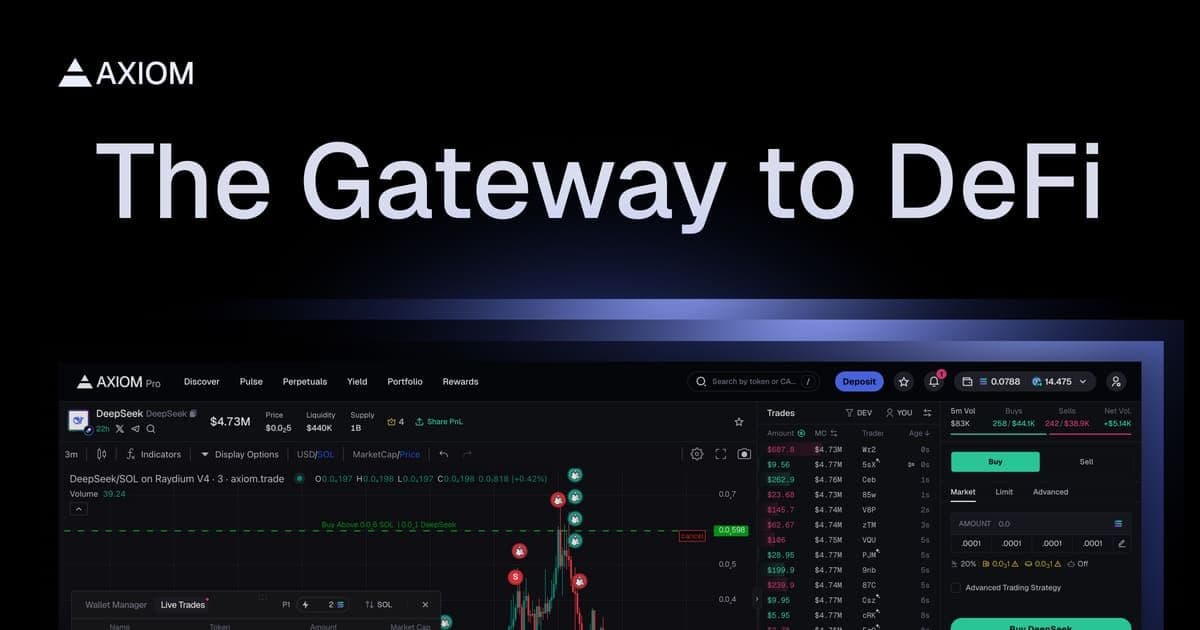
Axiom isn't a Telegram bot. It's a web-based trading terminal — everything happens inside the browser interface. That distinction matters because it means you get a full visual dashboard with charts, order panels, analytics, and wallet tracking all in one screen, rather than typing commands into a chat window and hoping the syntax is right.
Order Routing and Execution Architecture
Axiom runs colocated RPC nodes that execute trades within one Solana block — typically under 400 milliseconds. Your transaction path goes from click to Axiom's infrastructure to on-chain confirmation without bouncing through generic public RPCs that introduce variable latency. For MEV protection, Axiom offers three distinct modes: Off (no protection), Reduced (submitted via Jito, some risk remains), and Secure (whitelisted validators only — slower but maximum protection). Axiom recommends Secure mode whenever possible. The optional Jito tip (bribe) defaults to 0.001 SOL and increases transaction safety, though it's not 100% effective.
Turbo Mode is the flagship execution feature. It optimizes priority fee structure and routing for maximum speed during new token launches, targeting that sub-400ms execution window. This is the mode you activate when milliseconds determine whether you get filled at 0.00001 or 0.00003.
Sniper and Launch Tools
The Migration Sniper automatically buys tokens the instant they graduate from Pump.fun to Raydium, landing in one block or less. The Launch Bot automatically buys new memecoins at scheduled times and attracted 7,200 active users in its first month. These tools monitor liquidity pool creation events and trigger buys based on your preconfigured parameters — slippage tolerance, gas priority, and token filters.
Bundle Detection flags coordinated snipes that signal potential rug pulls or wash trading. Built-in Rug Checks automatically scan for honeypots, unlocked liquidity, mutable contracts, bundled launches, insider signals, reused socials, and dev migrations. This is your first line of defense before capital goes in.
Copy Trading Engine
Copy Trading lets you mirror high-win wallets with adjustable parameters: entry sizes, multi-take-profits, trailing stops, DCA, and risk caps. The Wallet & Twitter Tracker follows smart money and whale movements in real time, with a built-in Twitter feed that tracks mentions, dev updates, and sentiment spikes. You're not just copying trades — you're monitoring the context around those trades.
Common Mistake — and the Fix
One mistake traders make immediately: running the Migration Sniper with MEV protection set to Off. During high-demand launches, this exposes your snipe to front-running bots that detect your pending transaction and push the price up before your fill lands. The fix is straightforward — set MEV protection to Secure mode for any snipe where you're competing against bots for a first-block entry. It's slower by a small margin, but your effective fill price will be better.
Setting Up Axiom — Complete Step-by-Step for First-Time Users
1. Create and Connect Your Account
Navigate to axiom.trade. You have three onboarding options: connect via Phantom wallet, sign in with email, or use your Google account. Phantom is the most common path for existing Solana traders, but the email and Google options create a non-custodial Turnkey MPC wallet automatically — no private key paste required to start. Pick the method that matches your existing setup. The interface loads immediately after connection.
2. Fund Your Trading Wallet
Axiom uses a separate trading wallet from your personal wallet, similar to Photon's model. This is a non-custodial wallet secured by Turnkey's MPC infrastructure with air-gapped architecture — you control your keys at all times. Deposit SOL from a CEX or personal wallet directly to your Axiom trading wallet address. As of July 2025, Axiom also added a Coinbase-powered fiat on-ramp that lets you buy up to $500/week in crypto without KYC. You can view your recovery key inside the Account & Security settings panel.
3. Configure RPC and Priority Fee Settings
Open the settings panel and review the priority fee defaults. The default priority fee is 0.001 SOL, and the optional Jito tip (bribe) also defaults to 0.001 SOL. For standard swap trades on established tokens, the defaults work fine. For sniping new launches, enable Turbo Mode to let Axiom optimize fee routing for maximum speed. Set your MEV protection to Secure mode for high-stakes entries — whitelisted validators only. For casual swing trades, Reduced mode balances speed and safety.
4. Set Up Your First Token Alert and Watchlist
Use Pulse — Axiom's token discovery feed — to spot new launches, trending tokens, and migration events in real time. To track a specific token, paste the contract address into the search bar and pin it to your active dashboard. Configure price and volume alerts so you don't have to stare at the screen. The Wallet & Twitter Tracker lets you follow specific wallets and see correlated Twitter activity — useful for tracking dev wallets or known alpha callers.
5. Execute Your First Manual Trade
Open the buy panel for your target token. Set your slippage tolerance — 1% works for established tokens, while 10-25% is common for brand-new launches where liquidity is thin and price moves fast. Review the transaction preview, which shows your expected fill, fees, and net token amount. Confirm the trade. After execution, the post-trade receipt breaks down exactly what you paid. For faster manual entries, configure Hotkeys — these enable millisecond actions for position entry and exit without clicking through the full panel.
6. Configure Copy Trading
Paste a target wallet address into the Copy Trading panel. Set your position size as a fixed SOL amount or percentage of your portfolio. Enable or disable auto-sell mirroring depending on whether you want to follow exits too. Configure multi-take-profits, trailing stops, and per-trade maximums to cap your risk. You can copy multiple wallets simultaneously — just make sure your total exposure across all mirrored positions doesn't exceed what you're comfortable losing if every trade goes wrong at once.
7. Set Up Stop-Loss or Take-Profit Automation
Axiom's Limit Orders use MEV-resistant execution paths and land in one block or less — the fastest limit orders in the market, never triggered by MEV. You can also deploy Auto-Strategies / One-Click Strategies that pair a buy with simultaneous limit orders for take-profit or stop-loss. DCA / Ladder Orders let you automate recurring buys at defined intervals. On Solana's AMM-based DEX environment, these conditional orders are monitored by Axiom's infrastructure and executed on-chain when your trigger price is hit.
8. Security Checklist Before Going Live
Confirm that your Axiom trading wallet is separate from your main holdings wallet. Review your recovery key in Account & Security. The platform is non-custodial with no KYC required for standard Solana trading. Axiom is backed by Y Combinator (Winter 2025 batch) — the only memecoin terminal with that level of institutional validation. Check the Rug Checks before every trade: automatic scans cover honeypots, unlocked liquidity, mutable contracts, bundled launches, insider signals, reused socials, and dev migrations. Don't skip this step, especially on tokens less than an hour old.
Axiom Fees Explained — What You Actually Pay Per Trade
Fees on a trading terminal aren't just a line item — they're a compounding drag on every position you take. Here's exactly what Axiom charges.
| Fee Type | Amount | Who Controls It | When It Applies | |---|---|---|---| | Platform trading fee (standard) | 0.9% per transaction | Axiom (fixed) | Every buy and sell | | Platform trading fee (with referral) | 0.7% per transaction | Axiom (fixed, referral-activated) | Every buy and sell | | Solana network fee | ~0.000005 SOL per transaction | Solana protocol | Every transaction | | Priority fee | Default 0.001 SOL (user-adjustable) | You | Every transaction | | Jito tip (bribe) | Default 0.001 SOL (optional) | You | Optional, per transaction |
Worked Example — Memecoin Flip
You buy $500 of a new Solana memecoin at launch using the sniper with priority fee set to 0.01 SOL. Using the referral rate:
- Entry fee: $500 × 0.7% = $3.50
- Priority fee + Jito tip: ~0.002 SOL ≈ ~$0.30 (at typical SOL prices)
- Token runs 2.5x. Your position is now worth $1,250.
- Exit fee: $1,250 × 0.7% = $8.75
- Total platform fees: $3.50 + $8.75 = $12.25
- Gross profit: $750. Net profit after platform fees: ~$737.75
- Platform fee as percentage of gross profit: ~1.6%
At the standard 0.9% rate, those same fees would be $4.50 + $11.25 = $15.75 — roughly $3.50 more. That gap widens fast if you're executing 10-20 trades per day.
Worked Example — Copy Trading Over a Week
You mirror a whale wallet for 7 days and execute 12 mirrored trades averaging $200 each. Total volume: $2,400 in buys, and assume equivalent sells — $4,800 total transaction volume.
- At 0.7% (referral): $4,800 × 0.7% = $33.60 in platform fees
- At 0.9% (standard): $4,800 × 0.9% = $43.20 in platform fees
That's almost $10 saved per week just from the referral rate — and that's on relatively modest volume.
Fee Competitiveness
Axiom's 0.7% referral rate is lower than Photon's standard 0.9% rate. For traders executing meaningful daily volume, this difference compounds significantly over a month of active trading.
Sign up via Axiom to get a lifetime 0.7% fee rate (vs 0.9% standard) — only available through the ApexAlpha referral. There's also a volume-based rebate program for high-frequency traders that further reduces effective costs.
Who Should Use Axiom — And Who Should Look Elsewhere
Profile 1: The Memecoin Launch Sniper
You live for the first 60 seconds of a new token's life. You need sub-second execution, automatic detection of Pump.fun migrations, and MEV protection so your entry doesn't get sandwiched. Axiom's Migration Sniper lands buys in one block or less, Turbo Mode optimizes routing for maximum speed, and Bundle Detection flags coordinated snipes before you commit capital. This is the exact use case the platform was built around.
Profile 2: The Copy Trader
You've identified 5-10 consistently profitable wallets and want to mirror their entries without building a custom tracking stack. Axiom's Copy Trading engine handles entry mirroring, multi-take-profits, trailing stops, and DCA — all configurable per wallet. The Wallet & Twitter Tracker gives you context on why a tracked wallet is moving, not just that it moved. If your alpha strategy is "follow smart money," this is the most integrated tool available on Solana.
Profile 3: The Semi-Automated Swing Trader
You trade memecoins and microcaps but don't want to babysit every position. You need conditional exits — take-profit at 2x, stop-loss at -30% — without writing scripts. Axiom's Limit Orders are MEV-resistant and land in one block. One-Click Strategies let you deploy a buy with simultaneous limit orders attached. Integrated on-chain analytics (holder distribution, dev wallet activity, top 10 concentration) mean you don't need to switch to Birdeye or DEX Screener for research.
Who Should Skip Axiom
Multi-chain traders focused on Ethereum or BNB. Axiom is Solana-native. It's expanding to Ethereum, Base, and BNB Chain, but the core tooling and speed advantages are built around Solana's architecture. If your primary volume is on Ethereum, this isn't your terminal — yet.
Low-frequency holders executing fewer than 5 trades per week. At low trade counts, the learning curve of configuring priority fees, MEV modes, and sniper parameters doesn't justify itself. The feature depth that makes Axiom powerful for active traders creates a steeper learning curve for beginners. If you're buying and holding one memecoin a week through Phantom, the free path works fine.
Common Mistakes Axiom Users Make — And Exact Fixes
Mistake 1 — Under-Setting Priority Fees on Launch Snipes
During a high-demand token launch, dozens of bots and thousands of traders compete for first-block entries. Running the default 0.001 SOL priority fee during a Pump.fun migration means your transaction sits behind everyone who set a higher fee. Your snipe either fails or lands blocks late at a worse price.
Fix: For contested launches, manually increase the priority fee and enable Turbo Mode, which optimizes fee routing for maximum speed. Watch the first few seconds of trading — if you see the token price moving 5-10x in the first block, that's a signal you need aggressive priority settings.
Mistake 2 — Running Copy Trading Without Position Size Caps
Traders paste a whale wallet address, set position size to match the source wallet's entries, and forget that the whale is trading with 500 SOL while they have 10. One bad trade wipes out a disproportionate amount of capital.
Fix: Always set a fixed SOL amount per trade or a conservative percentage of your portfolio. Enable per-trade maximums. If you're mirroring a wallet with 50x your capital, your mirrored position sizes should be capped, not proportional.
Mistake 3 — Ignoring Rug Check Warnings on New Tokens
Axiom's built-in Rug Checks scan for honeypots, unlocked liquidity, mutable contracts, bundled launches, insider signals, reused socials, and dev migrations. Some traders see these warnings, dismiss them because "the chart looks good," and ape in anyway. Three minutes later, liquidity is pulled.
Fix: Treat Rug Check flags as hard filters, not suggestions. If the scan shows mutable contracts or unlocked liquidity on a token that's less than an hour old, skip it. There will always be another launch. There won't always be another bankroll.
Mistake 4 — Leaving MEV Protection on "Off" for Standard Trades
Some traders disable MEV protection thinking it speeds up execution. For standard swaps on established tokens, this exposes you to sandwich attacks that worsen your fill price. The cost is invisible — you don't see the MEV extraction as a fee, you just get fewer tokens than you should have.
Fix: Use Reduced mode as your minimum default. Switch to Secure mode (whitelisted validators only) for any trade where you're buying significant size. Only use "Off" if you fully understand the tradeoff and you're executing tiny test positions.
Pro tip: Before every trading session, take 30 seconds to verify three settings — MEV protection mode, priority fee level, and slippage tolerance. Most costly mistakes happen because yesterday's settings don't fit today's trade.
Frequently Asked Questions
Is Axiom Trade safe to use with real funds?
Axiom is non-custodial — your wallets are secured by Turnkey's MPC infrastructure with air-gapped architecture, and you control your keys at all times. The platform is backed by Y Combinator (Winter 2025 batch), which involves a rigorous vetting process. No KYC is required for standard Solana trading. You can view your recovery key in the Account & Security settings, and you should store it separately from your main holdings wallet.
What are Axiom's trading fees compared to Photon?
Axiom charges 0.9% per transaction at the standard rate, which is the same as Photon's standard rate. With a referral link, Axiom drops to 0.7% per transaction — a permanent reduction that Photon doesn't currently match. On top of platform fees, you pay Solana network fees (~0.000005 SOL) and user-set priority fees (default 0.001 SOL). There's also a volume-based rebate program for high-frequency traders.
Does Axiom work on mobile?
Axiom is web-based only — there's no dedicated mobile app. However, the terminal works in mobile browsers. The experience is functional but the feature depth is better suited to a desktop or tablet screen, especially if you're configuring sniper tools, setting up copy trading parameters, or monitoring multiple tokens simultaneously. For quick manual trades, mobile browser works fine.
How fast is Axiom's execution compared to using Jupiter or Raydium directly?
Axiom's colocated RPC nodes execute trades within one Solana block — typically under 400 milliseconds. When you trade through a standard DEX frontend, your transaction goes through a public RPC, sits in a shared queue, and competes without priority routing. Axiom's Turbo Mode further optimizes fee routing for new launches. The Migration Sniper specifically lands buys in one block or less when tokens graduate from Pump.fun to Raydium.
Can I use Axiom for tokens other than memecoins?
Yes. Axiom supports any SPL token tradable on Solana DEXs, and it now integrates Hyperliquid perpetuals for leveraged futures trading and MarginFi yield for earning passive income on idle funds. The platform is expanding to Ethereum, Base, and BNB Chain as well. That said, the sniper tools, launch detection via Pulse, and Migration Sniper are specifically optimized for the new-token and memecoin trading workflow.
The Verdict — Should You Trade on Axiom in 2026?
Axiom is the most feature-complete Solana trading terminal available right now, and the numbers back that up — over $10.5 billion in volume in its first 129 days, 1.29 million monthly users, and Y Combinator validation that no competitor can claim. If you're an active Solana trader executing more than a handful of trades per day — whether you're sniping launches, copying wallets, or running conditional exits — this platform eliminates the tool fragmentation that costs you fills and time. It's not a beginner tool, and it's not trying to be. For the trader who knows what they want to do and needs the execution infrastructure to do it at speed, Axiom is the current standard.
Memecoin trading carries significant risk. Only trade with funds you can afford to lose. Always do your own research before entering any position.