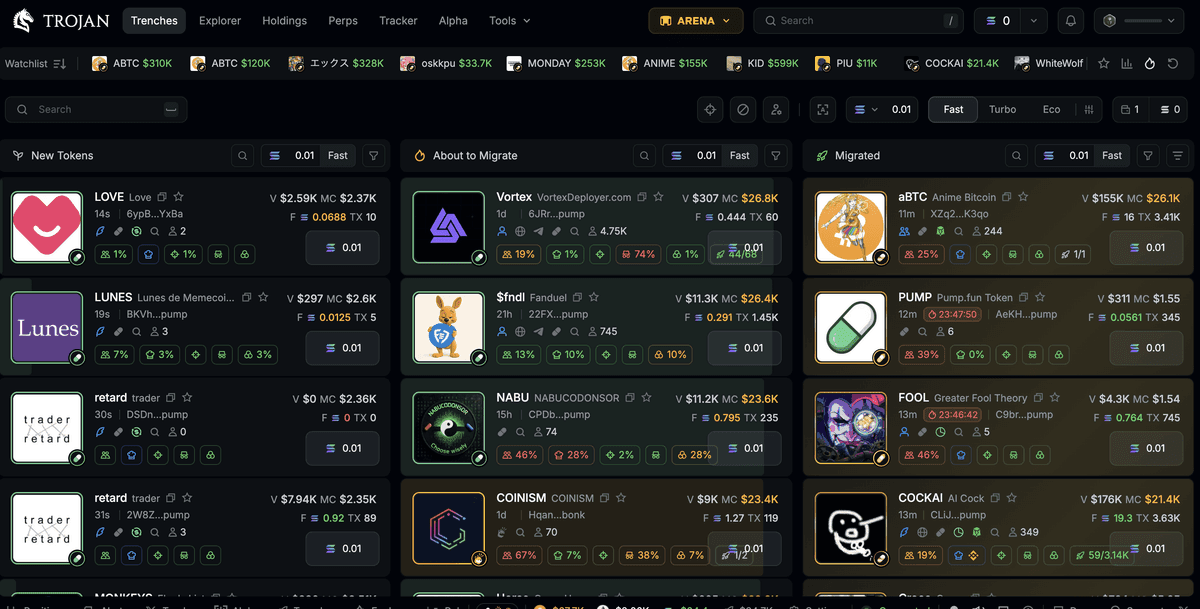
You set a perfectly sized buy on a hot Solana token — and somehow, every single time, you get a worse fill than the price you saw. That's not bad luck. That's an MEV bot reading your transaction before it lands and cutting in front of you. Understanding Trojan MEV protection via JITO slots is the difference between silently bleeding money on every trade and actually getting the price you clicked.
The fix already exists. It's built directly into Trojan — the largest Telegram trading bot on Solana with over $23.4 billion in lifetime volume — and most traders walk right past it in the settings menu without ever switching it on. That single toggle routes your transaction through private JITO validator slots, keeping it invisible to every sandwich bot scanning the network.
This guide breaks down exactly what happens to your transaction when MEV protection is enabled, what it costs in real dollars, and how to turn it on in under 60 seconds. No abstract theory. Just the mechanics, the math, and the steps.
The MEV Problem Every Solana Trader Is Quietly Paying For
MEV — Maximal Extractable Value — is profit that bots extract from your trades by manipulating transaction ordering. In practice, it looks like this: a bot sees your pending buy in the public mempool, submits an identical buy at a fractionally higher gas tip so it executes before yours, drives the price up, and then dumps into your now-inflated fill. You paid more. The bot pocketed the difference. You never even knew it happened.
Solana is a high-value MEV target for a specific reason. Sub-second block times combined with public mempool visibility mean bots can detect, replicate, and front-run your transaction in milliseconds. On a competitive token — a new launch, a trending memecoin with thin liquidity — sandwiched trades routinely cost 0.3–1.5% in slippage-equivalent losses. On a $500 trade, that's $1.50 to $7.50 gone. On a $2,000 trade during a launch, it can easily exceed $30.
Three attack types dominate what traders encounter on-chain:
- Sandwich attacks — a bot buys before you and sells after you, profiting from the price movement your own trade creates
- Frontrunning — a bot copies your exact trade and executes it first, getting the better price and leaving you with the worse one
- Backrunning — a bot places a trade immediately after yours to capture the price impact you just generated
Without protection, every trade you submit on a high-volume token is effectively broadcast to every MEV bot operator on the network before it confirms. You're showing your hand to the entire table, every single time. The bots don't sleep, they don't miss, and they operate at a scale most traders never realize — until they start comparing expected price to actual fill.
What JITO Is and Why Trojan Uses It
The Block Engine That Changed Solana MEV
JITO is Solana's dominant MEV-aware block engine. Validators running JITO software process transaction bundles through a system that allows private submission channels, bypassing the standard public gossip layer where bots sit and listen. Think of the public mempool as an open radio frequency — every pending transaction is audible to anyone tuned in. JITO creates a private channel.
How Your Transaction Stays Hidden
When you send a trade through Trojan with MEV protection enabled, your transaction doesn't enter the public mempool at all. Instead, it goes directly into a JITO bundle — a sealed, ordered group of transactions submitted straight to the block leader. The bundle is atomic: it either executes exactly as submitted or doesn't execute at all. No bot can insert a transaction in front of yours inside that bundle because the bundle's order is locked at submission.
The privacy window is what matters here. Between the moment you submit and the moment your transaction lands in a confirmed block, it's invisible. Sandwich bots can't see it. They can't replicate it. They can't front-run it. Your trade arrives in the block as if it appeared from nowhere.
Why Validators Accept JITO Bundles
JITO validators earn a tip — a small SOL payment separate from the base transaction fee — for including your bundle. This is the economic incentive that makes private inclusion possible. Higher tips increase the probability that a validator prioritizes your bundle for fast, private inclusion in the next block. Currently, approximately 30% of validators provide JITO protected slots, which means coverage is substantial but not universal. This is also why MEV protection may slightly impact speed compared to standard public submission — your transaction needs to reach a JITO-enabled validator specifically.
Common Mistake: Confusing JITO Tips With Gas Fees
One mistake traders make constantly is treating the JITO tip as a gas fee replacement. It's not. The JITO tip is an additional payment on top of Solana's base transaction fee. You're paying both. The base Solana fee is roughly 0.000005 SOL — essentially free — while the JITO tip is a user-set value you control. Setting the tip to zero and expecting MEV protection to work defeats the purpose entirely. If you enable MEV protection, set a real tip. Even 0.001 SOL is enough for most standard trades.
Step-by-Step: Enabling JITO MEV Protection in Trojan
1. Open Trojan in Telegram and confirm your active wallet. Launch the Trojan bot through Telegram and make sure you're operating from the correct wallet. If you manage multiple wallets using Trojan's Multi-Wallet feature (up to 10 wallets supported), verify which wallet is currently selected on the main dashboard. MEV protection settings apply per-session, so you want to configure the wallet you're actually about to trade with.
2. Tap the Settings gear icon to open global configuration. Look for the gear icon in the top-right area of the bot interface. This opens the full configuration panel where you'll find all trade-related settings. Don't confuse this with token-specific settings that appear when you're viewing a particular token — you want the global settings panel that controls default behavior for every trade.
3. Scroll to the Transaction Settings section. Inside Settings, scroll past any display or notification preferences until you reach Transaction Settings. This section is distinct from Slippage Settings. They're separate controls. Transaction Settings governs how your transactions are submitted to the network — this is where MEV protection lives.
4. Locate the MEV Protection toggle and enable it. You'll see the MEV Protection toggle displaying its current state as ON or OFF. Tap it to enable. The toggle should change color to indicate it's active. A key detail here: Trojan lets you toggle MEV protection on or off for buys and sells separately. If you're primarily worried about sandwich attacks on your buys (which is where most MEV extraction happens), you can enable it for buys only and leave sells on standard submission for potentially faster execution.
5. Set your JITO Tip amount directly below the toggle. Directly beneath the MEV Protection toggle, you'll find the JITO Tip field. This is a SOL value you enter manually. For standard trades on moderate-volume tokens, 0.001 SOL is a reasonable starting point. For high-competition launches or tokens with heavy bot activity, increase to 0.003–0.005 SOL. Remember: this tip goes to the JITO validator for private block inclusion. It's not a gas fee. It's not Trojan's fee. It's the cost of staying invisible.
6. Save your settings and confirm the UI acknowledges the change. After setting your tip amount, save the configuration. Look for a success indicator — a checkmark or confirmation message — before navigating away. If you don't see confirmation, go back into Settings and verify the toggle is still active and your tip amount was retained. Don't assume it saved.
7. Run a small test trade to verify JITO bundle inclusion. Before committing real size, execute a test buy in the range of $5–$10 on any liquid token. After the trade confirms, check the transaction on Solscan. In the transaction detail view, look for a bundle identifier — this confirms your trade was submitted through a JITO bundle rather than the standard public mempool. If you see the bundle ID, your MEV protection is working correctly.
8. Adjust tip size based on real conditions going forward. Your first test trade gives you a baseline. If the trade confirmed quickly at your set tip, that level is sufficient for similar conditions. If it took noticeably longer or fell back to standard submission, consider increasing the tip for time-sensitive trades. Build a habit of adjusting the JITO tip based on what you're trading — 0.001 SOL for casual swaps, 0.003–0.005 SOL when you're sniping a launch or buying into a token with known bot activity.
The Real Cost of MEV Protection: Fees Broken Down With a Worked Example
Three separate cost layers apply to every Trojan trade with MEV protection enabled. Understanding each one prevents confusion and helps you calculate whether protection is worth it on a given trade.
Layer 1: Solana base transaction fee — approximately 0.000005 SOL per transaction. At current SOL prices, this rounds to fractions of a cent. Effectively zero.
Layer 2: Trojan platform fee — 1% per successful transaction at the standard rate, or 0.9% with a referral link. This fee is only charged on successful trades — failed transactions cost you nothing in platform fees.
Layer 3: JITO tip — user-set, paid directly to the block producer for private bundle inclusion. You control this amount.
Here's what that looks like on a real trade:
- Trade size: $500 into a mid-cap Solana token
- JITO tip: 0.002 SOL → at $140/SOL = $0.28
- Trojan platform fee (with referral): 0.9% of $500 = $4.50
- Solana base fee: ~$0.001
- Total all-in cost: approximately $4.78 on a $500 trade = ~0.96%
Now compare that to the same trade without MEV protection. On an actively traded token with bot competition, a sandwiched trade typically costs 1.5–2% in realized slippage — that's $7.50–$10.00 lost on a $500 position. The MEV protection tip of $0.28 potentially saves you $3–$5 net on a single trade.
Scale that up to a $1,000 position:
- JITO tip at 0.002 SOL: $0.28
- Trojan fee (with referral): $9.00
- Total cost: ~$9.28
- Without protection, sandwich loss at 1.5%: $15.00
- Net savings from protection: roughly $5.72 on one trade
The tip-size tradeoff is straightforward. A higher tip increases the probability of fast, private inclusion in the next block but adds to your cost. During launches or high-volume periods — when MEV bot activity peaks — paying 0.005 SOL is worth it because competition for block space is fierce and sandwich losses are largest. During quieter trading on established tokens, 0.001 SOL is typically sufficient.
One scenario to be aware of: if your JITO tip isn't competitive enough and no JITO validator picks up your bundle within the timeout window, the transaction may fall back to standard submission — meaning it enters the public mempool without protection. Watch for this on high-congestion periods and increase your tip accordingly.
Sign up via Trojan to get the 0.9% fee rate (10% off standard) — exclusive to ApexAlpha referrals.
Who Gets the Most Value From JITO Protection (And Who Probably Doesn't Need It)
Profile 1: Launch Snipers
If you're using Trojan's sniper features or its New Pairs / Pool Scanner to catch tokens the moment they migrate from Pump.fun to Raydium, MEV protection isn't optional — it's mandatory. The first blocks of any launch are peak MEV territory. Every bot on Solana is scanning those exact pools. Without JITO protection, your snipe transaction sits in the open mempool like a neon sign saying "sandwich me." Enable it, set the tip to 0.003–0.005 SOL, and treat it as part of the cost of playing early.
Profile 2: Mid-to-Large Position Traders
Anyone consistently trading above $500 per position should have MEV protection toggled on permanently. At that size, a 1–1.5% sandwich loss translates to $5–$15 per trade — far more than the $0.14–$0.70 a JITO tip costs. If you're executing 5–10 trades a day, the cumulative savings over a week add up fast. You don't need to run the math every time. Just leave it on with a 0.001–0.002 SOL tip as your default.
Profile 3: Copy Traders Noticing Bad Fills
Trojan's Copy Trading feature auto-follows buys and sells from specified wallet addresses. The problem: when a popular wallet makes a move, dozens of copy traders submit the same buy simultaneously — creating a predictable wave of transactions that MEV bots love to exploit. If you've been copy trading and consistently getting worse fills than the wallet you're following, MEV extraction is almost certainly the reason. Enable JITO protection on your copy trade executions.
Who Probably Doesn't Need It
Traders executing very small positions — under $50 — won't see meaningful savings from MEV protection. A 1% sandwich on a $20 trade is $0.20. The JITO tip at even the minimum 0.001 SOL (~$0.14) eats most of the potential savings, and at higher tip levels you'd actually pay more for protection than you'd lose to bots. If you're casually buying small amounts of established, high-liquidity tokens where sandwich activity is low, standard submission is fine. Save the tips for when they matter.
Similarly, if you exclusively trade high-liquidity established tokens with deep order books and tight spreads, sandwich attacks are less profitable for bots and therefore less frequent. You won't be entirely immune, but the economics of protection shift — the savings per trade are smaller, and you might prefer the marginally faster execution of standard submission.
Common Mistakes That Undermine Your MEV Protection
Mistake 1: Enabling MEV Protection but Setting the JITO Tip to Zero
Why traders do it: They see the toggle, flip it on, and assume the default tip is enough — or they try to save money by leaving the tip field empty or at zero. What happens: Without a competitive tip, no JITO validator has an incentive to include your bundle. Your transaction either sits in limbo or falls back to standard public submission, completely unprotected. Fix: Always set a minimum tip of 0.001 SOL. It costs roughly $0.14 at $140/SOL. That's the price of the protection actually working.
Mistake 2: Using the Same Tip for Every Market Condition
Why traders do it: They set 0.001 SOL once and forget about it. What happens: During launches, high-volume periods, or network congestion — exactly when MEV bots are most active — a low tip means your bundle gets deprioritized. You might experience delayed execution or fallback to unprotected submission at the worst possible time. Trojan even deploys Backup Bots during peak usage to ensure trades get through during congestion, but your JITO tip still needs to be competitive for private inclusion. Fix: Increase to 0.003–0.005 SOL when trading new launches, during market-wide volatility spikes, or when you notice slower-than-usual execution on protected trades.
Mistake 3: Forgetting to Enable MEV Protection on Sells
Why traders do it: Most traders think about sandwich attacks on buys and forget that sells are equally vulnerable. A bot can front-run your sell, dump before you, and you exit at a worse price. What happens: You protect your entry but hemorrhage value on exits — especially on volatile tokens where sell pressure triggers cascading bots. Fix: Trojan allows you to toggle MEV protection for buys and sells separately. Enable it for both. The cost per transaction is identical, and sell-side sandwiching is just as real.
Mistake 4: Never Verifying That Trades Are Actually Hitting JITO Bundles
Why traders do it: They assume the toggle means protection is active and never check. What happens: Settings can revert, tips can be too low for inclusion, or network conditions can cause fallback to standard submission — and you'd never know unless you look. Fix: Periodically check your transactions on Solscan. Look for the JITO bundle identifier in the transaction details. If your recent trades don't show bundle inclusion, your settings need adjustment.
Pro tip: Bookmark one Solscan link to a confirmed JITO-bundled transaction so you know exactly what the bundle identifier looks like. Comparing future transactions takes five seconds and confirms your protection is live.
FAQ: What Traders Actually Ask About Trojan MEV Protection
Does enabling MEV protection slow down my trades on Trojan?
It can, marginally. Because your transaction must reach a JITO-enabled validator specifically — and roughly 30% of validators provide JITO protected slots — there's a slightly narrower pool of validators that can process your bundle. Trojan's BOLT execution already targets under 2 seconds per trade, and MEV-protected transactions may take slightly longer depending on network conditions and your tip amount. For most trades, the difference is imperceptible. For time-critical snipes during launches, increase your JITO tip to maximize inclusion speed.
Is the JITO tip the same as Trojan's 1% trading fee?
No. They're completely separate charges. Trojan's platform fee is 1% per successful trade (or 0.9% with a referral link), and it goes to Trojan. The JITO tip is a separate SOL payment you set manually, and it goes directly to the block-producing validator who includes your transaction privately. You pay both on a protected trade. The JITO tip is typically 0.001–0.005 SOL — a fraction of the platform fee on any meaningful trade size.
Can MEV bots still attack me if I have JITO protection on?
If your transaction is properly included in a JITO bundle, sandwich bots cannot see or front-run it — the transaction never enters the public mempool where bots operate. The risk comes if your tip is too low and the transaction falls back to standard submission, at which point it loses protection entirely. Set a competitive tip and verify your trades are landing in bundles on Solscan to confirm you're fully covered.
Do I get charged the JITO tip if my trade fails?
The JITO tip is paid for bundle submission regardless of whether your trade succeeds or fails at the application level. However, Trojan's platform fee is only charged on successful transactions — failed trades incur no Trojan fee. So a failed trade with MEV protection costs you the JITO tip (a few cents) plus the negligible Solana base fee, but nothing else.
Should I use MEV protection when I'm copy trading on Trojan?
Yes — especially if you're copying popular wallets. When a tracked wallet makes a move, multiple copy traders submit simultaneous buy orders on the same token, creating a predictable cluster of transactions that MEV bots specifically target. Enabling JITO protection on your Copy Trading executions ensures your transaction stays private even when dozens of others are hitting the same token at the same moment. Set a tip of at least 0.002 SOL to stay competitive during these clustered-order scenarios.
The Verdict: A $0.14–$0.70 Setting That Pays for Itself
MEV protection via JITO slots is the single highest-value setting most Trojan users never activate. For the cost of a fraction of a SOL per trade, you remove yourself from the sandwich bot food chain — and on any position above $100, the math consistently favors protection over exposure. If you trade on Solana with any regularity, especially on new launches or competitive tokens, enable it, set a reasonable tip, and leave it on. The bots don't take days off, and neither should your protection.
Memecoin trading carries significant risk. Only trade with funds you can afford to lose. Always do your own research before entering any position.