A split-second hesitation on a $10,000 swap can cost you $40 to $200 in missed value — and that's before you've even clicked confirm. If you're still manually checking which DEX gives the jupiter ultra best swap price on Solana, you're already losing. The market moves faster than your browser tabs.
Here's the core issue: Solana now has dozens of liquidity pools, AMMs, and order books firing simultaneously. Orca, Raydium, Meteora, Phoenix, Lifinity — each carries different prices for the same token pair at any given second. No human can monitor them all at once, and no single venue consistently offers the best rate. You're either routing intelligently or you're paying a hidden tax on every trade.
This guide breaks down the exact mechanics of how Jupiter Ultra V3 finds and executes the best available price across all of Solana's fragmented liquidity. You'll learn how the Iris Meta-Aggregator Router splits your trades, what each setting in the UI actually does, what the real fee stack looks like down to the dollar, and how to configure everything so you stop leaving money on the table. No hand-waving — just the mechanics that matter.
Why Solana's Liquidity Fragmentation Is a Real Trading Problem
Solana's DEX ecosystem isn't one pool. It's dozens of competing venues — Raydium, Orca, Meteora, Phoenix, Lifinity, and more — each with their own AMM curves, fee structures, and pool depths. For popular pairs like SOL/USDC, that fragmentation might seem harmless because liquidity is deep everywhere. But for mid-cap tokens, memecoins, and anything outside the top 20, the price difference between venues at any given moment can be substantial.
Think about what actually happens when you swap $5,000 of SOL into a mid-cap token on a single AMM. You're hitting one pool. If that pool holds $50,000 in total liquidity, your trade represents 10% of the pool depth. The AMM's bonding curve punishes you for it — your effective price per token gets worse with every fraction of SOL you push through. Price impact of 1–3% on a trade that size is common in thinner pools. On $5,000, that's $50 to $150 gone. Just gone.
Now consider the same trade split across three venues: 40% through Raydium's deepest pool, 35% through Orca's concentrated liquidity position, and 25% through a Meteora pool. Each leg hits a shallower portion of each pool's curve. The aggregate price impact drops dramatically.
This is the "routing tax" most traders pay without realizing it. They pick one DEX out of habit — maybe the one they bookmarked six months ago — and execute there every time. They never see the cost because it's embedded in the price, not listed as a fee. Jupiter handles approximately 95% of Solana's DEX aggregator market share and over 50% of all Solana DEX trading volume because it eliminates this invisible tax. Ultra V3 is the engine that does the heavy lifting, and understanding it turns you from a price-taker into someone who extracts the best available price on every single swap.
How Jupiter Ultra V3 Routing Actually Works — The Mechanics
Ultra V3 isn't just a price comparator that checks a few DEXs and picks the cheapest quote. Launched in October 2025, it's a fundamental re-architecture of Jupiter's execution layer — an active, vertically integrated execution manager that treats every trade as an optimization problem.
Route Discovery Happens in Parallel, Not Sequentially
When you enter a swap on Jupiter, Ultra V3 queries all integrated liquidity sources simultaneously. Raydium, Orca, Meteora, Phoenix, and every other connected venue get hit at the same time. On a blockchain with ~400ms block times, sequential querying would mean your first quote is already stale by the time the last one arrives. Parallel discovery eliminates that latency gap. The Iris Meta-Aggregator Router — Jupiter's proprietary routing engine — integrates exclusive liquidity sources beyond what any single DEX offers, finding trade paths that simply aren't visible if you're looking at one venue.
Split Routing Reduces Price Impact Across Multiple Pools
This is where the real savings happen. Instead of pushing your entire trade through one pool, Ultra V3 can divide a single swap across multiple pools and multiple hops simultaneously. A SOL→USDC trade might route 60% directly through Orca's concentrated liquidity and 40% through Raydium — or it might find that SOL→mSOL→USDC through Meteora and a direct SOL→USDC leg through Phoenix yields a better blended rate. The engine tests these combinations in real time and picks the split that delivers the highest output amount.
Price Impact Modelling Before Execution
Here's what separates a true aggregator from a quote comparison site. Ultra V3 simulates the post-trade state of each pool before committing your transaction. It doesn't just look at the current quoted price — it calculates what the price will be after your order hits the pool, accounting for the AMM's bonding curve and current depth. This means the "estimated received" figure you see is modelled on actual post-impact pricing, not optimistic pre-trade quotes.
Dynamic Recalculation at Broadcast
Route splits are recalculated at the moment of transaction broadcast, not at the moment you first requested a quote. If pool states shift between when you loaded the quote and when you click confirm, Ultra V3 adjusts. In volatile markets, this matters enormously.
Common mistake: Traders set a quote, walk away for 30 seconds, then confirm — assuming the displayed price is still valid. Even with dynamic recalculation, extreme volatility can push the actual execution outside your slippage tolerance, causing the transaction to fail. The fix: confirm promptly after reviewing the route, and set an appropriate slippage tolerance for the market conditions rather than relying on stale quotes.
Setting Up Ultra V3 for Optimal Routing — Step-by-Step
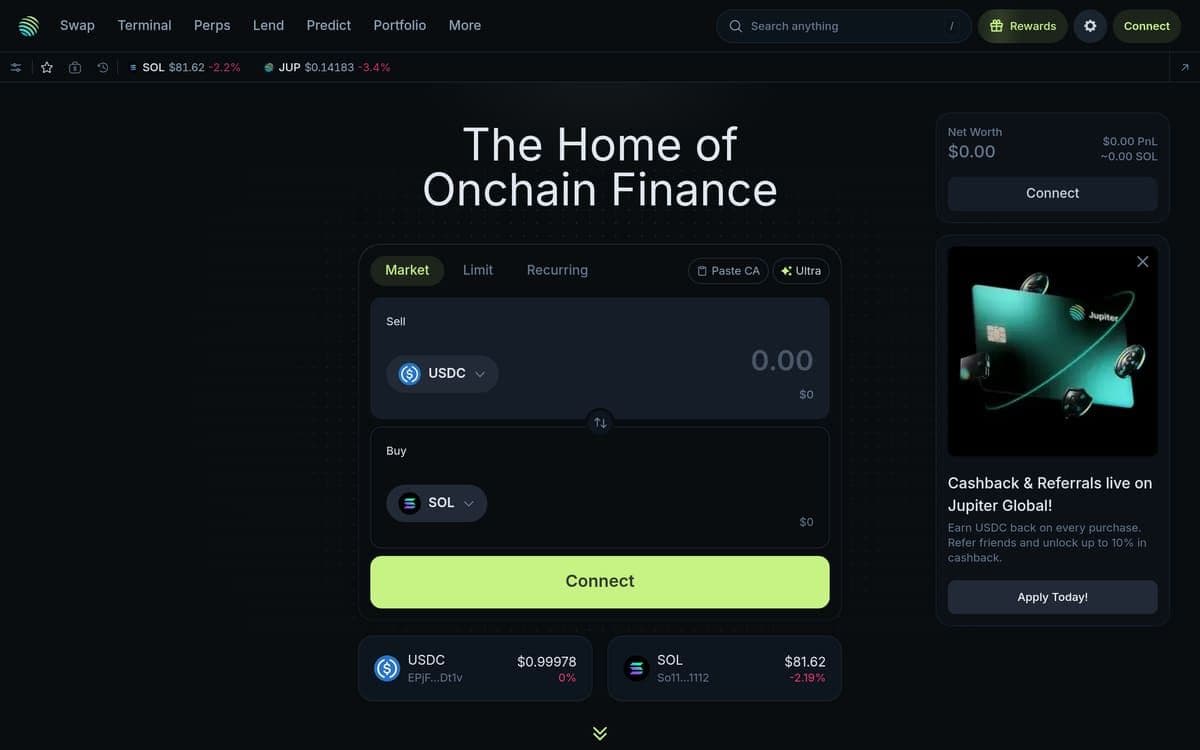
1. Navigate to the Jupiter swap interface. Go directly to jup.ag. Ultra V3 is now the default routing engine powering Jupiter's swap page — you don't need to toggle into a separate "Ultra mode." If you're on a legacy bookmark or an older embedded terminal from a third-party app, make sure you're on the main jup.ag domain to get the latest routing engine. The interface will show the swap panel front and center.
2. Connect your wallet. Click the "Connect Wallet" button in the top right. Jupiter natively supports Phantom, Solflare, Backpack, and other major Solana wallets. If you're using a hardware wallet like Ledger through Phantom or Solflare, expect an additional confirmation step on the device itself — this adds a few seconds to execution, which can matter on time-sensitive trades. Make sure your wallet has a small SOL balance for network fees (the Solana network fee is approximately $0.001 per transaction).
3. Select your token pair and verify the mint address. Use the token selector dropdowns to choose your input and output tokens. For well-known tokens like SOL, USDC, or JUP, this is straightforward. For lesser-known tokens — especially memecoins — always click the token name after selecting it and verify the mint address displayed in the UI. Scam tokens with identical names and logos exist. If someone sent you a contract address, paste it directly into the search bar rather than scrolling through the list. This single habit prevents the most common on-chain scam vector.
4. Set slippage tolerance correctly. This is the most misconfigured setting in DeFi. Jupiter offers an auto-slippage recommendation that adapts to current market conditions and the specific pair you're trading — use it as your default for blue-chip pairs like SOL/USDC. For low-liquidity tokens during high volatility, you may need to set manual slippage slightly wider — but be careful. Anything above 3% opens you up to MEV extraction, where bots can sandwich your transaction and extract the difference. Start with auto-slippage, and only go manual when transactions are failing due to price movement.
5. Read the route preview before confirming. After entering your trade amount, Jupiter displays a route breakdown below the swap button. This shows exactly which pools are being used, the split percentages across venues, estimated price impact, and the minimum amount you'll receive. Study this. If you see 100% of your trade going through a single pool with high price impact, that's a signal that liquidity for this pair is thin — consider sizing down. The "minimum received" number is what you're guaranteed if slippage tolerance is hit; the "estimated received" is the expected output under current conditions.
6. Review MEV protection settings. Jupiter's Ultra V3 includes MEV protection that helps shield your trades from sandwich attacks. For larger trades (think $1,000+) and volatile tokens, this is worth keeping active. It introduces marginal latency — your transaction may take slightly longer to land — but the protection against front-running is worth it in most cases. Check the settings gear icon near the swap panel to confirm it's enabled.
7. Confirm the transaction and verify on-chain. Hit confirm, approve in your wallet, and then check the actual received amount — not just the quote. Jupiter's confirmation screen shows the final output. For a second verification, click through to view the transaction on Solscan or SolanaFM (Jupiter acquired SolanaFM, so block explorer integration is native). On fast-moving assets, the actual received amount may differ from the estimate by a small margin. That's normal. What matters is that it stayed within your slippage tolerance.
8. Power users: tap the API for programmatic routing. If you're running bots, scripts, or high-frequency strategies, Jupiter's API underlies Ultra V3 and exposes the same routing engine programmatically. Active traders who need custom routing parameters, pre-trade simulation, or batch execution should explore the Jupiter developer docs. The API gives you everything the UI does — minus the point-and-click.
The Real Cost of Using Jupiter Ultra V3 — Fees Decoded
Let's be specific, because vague fee descriptions help nobody.
Jupiter charges 0% platform fee on token swaps. Zero. The only fees you pay on a standard swap are the underlying DEX fee from whatever pool(s) your trade routes through — typically ~0.25–0.3% depending on the venue and pool type — plus the Solana network fee of roughly $0.001 per transaction.
Here's a worked example. You swap $5,000 of SOL into USDC. Jupiter takes $0 in platform fees. Your trade routes across two pools: 65% through Orca (0.25% LP fee) and 35% through Raydium (0.25% LP fee). The blended LP fee is 0.25%, which comes to $12.50. Solana network fee adds about $0.001. Your total cost: approximately $12.50, or 0.25% of trade size. If you'd executed the same $5,000 on a single thin pool with 0.8% price impact, you'd have paid $40+ in effective cost — the routing saved you roughly $27.50 on one trade.
On a smaller $500 swap, the math scales: $0 Jupiter fee, ~$1.25 in LP fees, ~$0.001 network fee. Total: about $1.25. The savings from split routing on smaller trades might only be a few cents to a dollar, but they compound over dozens of trades per week.
When costs rise: During network congestion, Solana priority fees can spike from fractions of a cent to $0.01–$0.10 or more — still negligible compared to other chains, but worth noting. Low-liquidity routes that require more hops mean more LP fees stacked on top of each other. Very large trades (five figures and up) can still hit price impact limits even with split routing if total available liquidity across all venues is thin.
Compared to alternatives: Executing the same swap directly on Raydium or Orca means you're paying their LP fee anyway — but without the benefit of split routing, so your price impact is likely higher. Against a CEX like Binance, Jupiter wins on custody (your keys, your tokens) and often matches or beats on total effective cost for Solana-native pairs — though CEXs may offer tighter spreads on massive spot volumes.
One more thing: sign up via Jupiter to get zero platform fee on every swap — sign up via ApexAlpha for the best routing across all Solana DEXs.
Who Gets the Most Value from Ultra V3 — and Who Should Look Elsewhere
Traders Who Benefit Most
Active traders doing $1,000+ swaps regularly. At this size, basis-point differences in routing compound fast. If you're making 5–10 swaps a day and saving 0.2–0.5% per swap through better routing, that's hundreds of dollars a month you'd otherwise lose to price impact. Ultra V3 was built for this exact use case.
Mid-cap and low-cap Solana token rotators. If you're cycling between tokens like WIF, BONK, JTO, PYTH, or any of the rotating cast of Solana memecoins and DeFi tokens, liquidity is scattered across venues. One pool on Raydium might have depth for BONK/SOL while Orca has a better concentrated liquidity position. You don't want to check manually — you want the Iris Meta-Aggregator Router doing it for you across every source simultaneously.
Anyone trading illiquid pairs where single-venue price impact exceeds 1%. This is where routing saves the most money in absolute terms. If you're buying a newer memecoin with $200K in total DEX liquidity, a $2,000 swap on one pool creates brutal impact. Split routing across every available pool — even if some legs are small — measurably reduces your effective price.
Traders Who Should Look Elsewhere
New-token snipers. If your strategy depends on being among the first buyers at token launch — within seconds of the pool going live — Jupiter isn't the right tool. Route discovery and optimization add latency that sniper bots don't tolerate. Jupiter itself acknowledges this: it's not built for memecoin sniping at launch. Use dedicated tools like Axiom or Trojan for new token speed, then rotate into Jupiter for subsequent trades once liquidity stabilizes.
Traders who need absolute minimum latency above all else. If you're running a MEV strategy or arbitrage bot where every millisecond counts, direct pool interaction via custom smart contracts will be faster than routing through an aggregation layer. Ultra V3 is optimized for best price, not lowest latency. For 99% of traders, the difference is imperceptible — but for that 1%, it's the whole game.
Common Mistakes That Cost Traders Money on Jupiter
Mistake 1: Using manual slippage set way too high. Traders who've had transactions fail on volatile tokens often crank slippage to 5%, 10%, or higher to "make sure it goes through." This is an open invitation for sandwich bots. They see your high tolerance, front-run your trade, inflate the price, let your swap execute at the worst end of your range, then sell. Fix: Start with Jupiter's auto-slippage. If transactions fail, increase manually in small increments — 0.5% at a time. Rarely should you go above 3%, and if you must, keep the trade size small.
Mistake 2: Not verifying the token mint address. Fake tokens with identical names, logos, and even similar ticker symbols exist on Solana. Traders search for a token name in the Jupiter selector, pick the first result, and swap into a worthless clone. Fix: Always verify the mint address against the project's official channels — their website, Twitter, or CoinGecko listing. Jupiter displays the mint address in the token selector; check it every time you trade a token you haven't traded before.
Mistake 3: Ignoring the route preview on large trades. The route breakdown shows you exactly how your trade will be split and what price impact to expect. Skipping this on a $5,000+ trade means you might not realize that 100% of your order is hitting a single shallow pool with 2%+ impact. Fix: Before every trade above $1,000, read the route preview. If impact is high, consider breaking the trade into two or three smaller swaps spaced a few seconds apart — the pools rebalance between executions, and your blended price improves.
Mistake 4: Assuming the quoted price is the final price. Jupiter shows an estimated received amount, but blockchain state changes between quote time and execution time. On fast-moving assets, this gap can be meaningful. Fix: Look at the "minimum received" field — that's your worst-case outcome within your slippage tolerance. Make decisions based on that number, not the optimistic estimate. After execution, verify the actual received amount in your wallet or on Solscan.
Pro tip: If you're trading the same pair multiple times a day, bookmark the direct Jupiter URL with your token pair pre-selected. It saves 5–10 seconds per trade and reduces the chance of selecting the wrong token.
Frequently Asked Questions
Does Jupiter Ultra V3 charge any platform fee on swaps?
No. Jupiter charges 0% platform fee on token swaps. The only costs you pay are the underlying DEX LP fee from whichever pools your trade routes through (typically ~0.25–0.3%) and the Solana network fee (~$0.001). This makes Jupiter one of the cheapest ways to execute swaps on Solana — the routing optimization often saves you more than the LP fee costs.
How does Ultra V3 split my trade across multiple DEXs?
The Iris Meta-Aggregator Router evaluates all available liquidity across Raydium, Orca, Meteora, Phoenix, and other integrated venues simultaneously. It calculates the optimal split — for example, 55% through one pool and 45% through another — based on which combination delivers the highest output amount after accounting for each pool's depth and price impact. The split is recalculated at the moment of transaction broadcast, so it reflects the freshest on-chain state.
Is Jupiter fast enough for sniping new memecoin launches?
Honestly, no. Jupiter's strength is best-price execution, not raw speed. The route discovery and optimization process — while fast in absolute terms — adds latency compared to direct pool interaction. For sniping new token launches within seconds of pool creation, dedicated tools like Axiom or Trojan are built for that purpose. Use Jupiter for everything after the initial snipe: subsequent buys, sells, and DCA accumulation.
What wallets work with Jupiter Ultra V3?
Jupiter natively supports Phantom, Solflare, Backpack, and most major Solana wallets. Hardware wallets like Ledger work through compatible wallet apps (Phantom or Solflare bridge), though you'll face an additional on-device confirmation step. This extra step adds a few seconds, so keep that in mind for time-sensitive trades.
How does Jupiter compare to just using Raydium or Orca directly?
Using Raydium or Orca directly means you're limited to that single venue's liquidity. You'll pay the same LP fee (~0.25–0.3%) either way, but without split routing, your price impact is higher on any trade that represents a meaningful percentage of the pool's depth. Jupiter routes across Raydium, Orca, and every other integrated venue simultaneously, so you get the best blended price. For deep blue-chip pairs the difference might be small; for mid-cap and low-cap tokens, it's often significant.
The Verdict: Ultra V3 Is the Default Routing Engine Solana Traders Should Be Using
Jupiter Ultra V3 with the Iris Meta-Aggregator Router does one thing exceptionally well: it finds you the best available price across all of Solana's fragmented liquidity, every single time, with no platform fee on swaps. If you're trading Solana tokens — whether you're doing $500 rotations between memecoins or $50,000 position entries — there's no rational reason to execute on a single DEX when Ultra V3 can check every venue and split your trade for optimal output in milliseconds. The platform handles over 50% of all Solana DEX volume and controls ~95% of the aggregator market for a reason: it works, it's free at the platform level, and the routing genuinely saves money that compounds over every trade you make.
Memecoin trading carries significant risk. Only trade with funds you can afford to lose. Always do your own research before entering any position.