Slippage eats your trade. A bad route costs you more than the gas ever will — and on Solana, where dozens of DEXs fragment liquidity across pools you'd never manually check, picking the wrong Jupiter Solana swap aggregator changes what you actually receive on every single transaction. The difference between a smart route and a lazy one on a $10,000 swap can be $30, $80, sometimes more. That's not a rounding error. That's a recurring tax.
Most traders don't think about their aggregator. They connect a wallet, paste a token address, hit confirm, and move on. But the routing logic behind that confirmation decides which pools your order touches, how it splits across venues, and whether you're exposed to sandwich attacks. Get it wrong and you bleed capital in ways that never show up as a line item. Get it right and you're compounding a small edge on every trade — hundreds or thousands of times a year.
This review breaks apart Jupiter's 2026 stack piece by piece. Routing mechanics, the real fee structure most guides gloss over, the new product lines like Jupiter Lend and JupUSD, and the specific scenarios where Jupiter quietly loses to competitors. If you're doing any meaningful volume on Solana, the next five minutes will either confirm your default or change it.
Why Your Swap Aggregator Choice Actually Costs You Money in 2026
Here's a concrete scenario. You want to swap $10,000 USDC into SOL. If you go directly to a single DEX — say one Raydium CLMM pool — you're hitting one liquidity source. The pool might have solid depth for $2,000, but at $10,000 you're pushing through tick ranges that thin out fast. Your price impact jumps to 0.5% or higher. That's $50 gone before you even factor in the LP fee.
Now run the same trade through an aggregator that splits your order across Raydium, Orca, Meteora, and Phoenix simultaneously. Each pool absorbs a smaller portion. Price impact drops to 0.05–0.1%. You just saved $40–$45 on a single swap. Do that three times a week and you're recovering over $6,000 a year.
Solana's DEX landscape has fragmented dramatically. Raydium runs concentrated liquidity pools. Orca has its own CLMM infrastructure. Meteora brought dynamic pools. Phoenix operates a full on-chain order book. New venues keep launching. No human can manually check price and depth across all of them in real time. That's the aggregator's job.
"Best execution" in 2026 means more than finding the cheapest quoted price. It means accounting for slippage tolerance, pool depth at your trade size, MEV exposure, and route reliability when the network is under load. Solana's on-chain volumes have surged — Jupiter alone facilitated over $80 billion in volume and 1.4 billion swaps in Q2 2025. Higher volumes mean more competition for block space, more MEV bots, and more variance between quoted and filled prices. Your aggregator choice isn't a preference. It's a cost center.
How Jupiter's Routing Engine Actually Works
Ultra V3 and the Iris Meta-Aggregator
Jupiter isn't just comparing prices across DEXs and picking the cheapest one. Ultra V3, launched in October 2025, re-architected the entire system into an active, vertically integrated execution manager. Think of it less as an aggregator and more as a trading engine that controls every step from quote to settlement.
At the core sits the Iris Meta-Aggregator Router. When you request a quote, Iris scans all major Solana DEXs simultaneously — Raydium, Orca, Meteora, Phoenix, and others — plus exclusive liquidity sources that aren't available to competing aggregators. It evaluates multi-hop paths (your USDC might route through SOL then into BONK if that produces a better final output than a direct pair), and it calculates whether splitting your order across two, three, or more pools reduces total price impact.
The decision to split vs. single-route depends on your trade size relative to pool depth. A $500 swap of SOL to USDC will almost always route through a single deep pool. A $25,000 swap of USDC to a mid-cap SPL token will likely split across three or four venues, with Iris assigning percentage allocations to each based on real-time liquidity depth and tick-range availability.
Why Quoted Price and Fill Price Can Differ
Jupiter shows you a quote that factors in pool depth, tick ranges on CLMMs, and your slippage tolerance. But between the moment you see that quote and the moment your transaction lands on-chain, pool states can shift. A large trade ahead of yours drains liquidity from the optimal tick range. Your fill moves.
This is where MEV protection matters. Jupiter batches and submits transactions in a way that reduces sandwich attack exposure — bots that front-run your swap, push the price up, then sell after you buy. Ultra V3's execution layer handles this, but it doesn't eliminate all MEV risk. Extremely thin pools and brand-new tokens remain vulnerable.
The Common Mistake That Costs Traders Here
Mistake: Trusting the quote on newly listed tokens without expanding the route panel. When a token has only one or two pools with shallow liquidity, Iris has limited options. The route might push 100% through a single pool with under $50K in TVL. If you don't check, you won't realize your $2,000 trade is about to eat 3%+ in price impact. Fix: Always expand the route preview. If any single pool in the route has obviously thin liquidity, either reduce your trade size or use Jupiter's DCA feature to break it into smaller executions over time.
Step-by-Step — How to Set Up and Execute a Trade on Jupiter in 2026
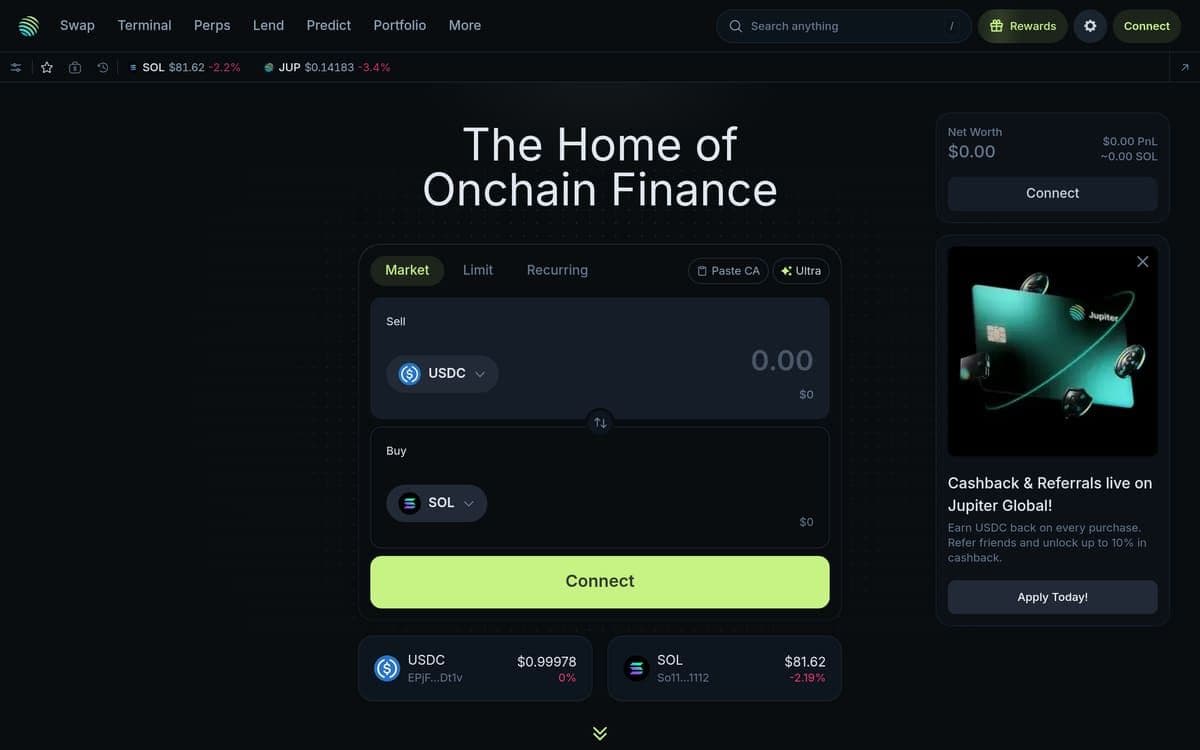
1. Connect your wallet at jup.ag. Navigate directly to jup.ag — bookmark it now and verify the URL every single time to avoid phishing clones. Click "Connect Wallet" in the top right corner and select Phantom, Solflare, or Backpack. Your wallet will ask you to approve the connection. Confirm, and you'll see your SOL balance reflected in the interface within seconds.
2. Set your slippage tolerance before doing anything else. Click the settings gear icon near the swap interface. For large-cap pairs like SOL/USDC, set slippage to 0.1–0.3%. For mid-cap and small-cap SPL tokens, start at 0.5% and only increase if transactions fail repeatedly. The default slippage isn't always appropriate — leaving it too loose on volatile tokens gives MEV bots room to extract value from your trade.
3. Select your input and output tokens using the contract address. Don't just search by ticker. Multiple tokens can share the same ticker on Solana. Paste the token's actual mint address into the search bar to confirm you're swapping the correct asset. You can find verified addresses on Birdeye, Solscan, or the project's official channels. This takes ten seconds and prevents you from buying a worthless clone token.
4. Read the route preview before confirming. Expand the route panel below the swap quote. You'll see exactly how many hops your trade takes, which DEX pools are involved, and what percentage of your order is allocated to each. If a pool you've never heard of is handling more than 30% of your trade, pause. Verify that pool on Birdeye or Solscan. Any pool with less than $500K TVL on a trade above $1,000 should make you cautious about price impact.
5. Check the price impact warning and decide whether to tranche. Jupiter flags any swap with over 1% price impact with a visible warning. That number tells you how much worse your execution price is compared to the current market price, purely because of your trade's size relative to available liquidity. If you see 1% or higher, consider splitting the trade into two or three smaller transactions spaced a few minutes apart, or use Jupiter's built-in DCA feature to automate the process.
6. Enable MEV protection for any trade over $500. Locate the MEV protection toggle in the settings panel — it's near the slippage controls. Switch it on before submitting. This tells Jupiter to batch your transaction in a way that reduces sandwich attack exposure. For smaller trades the risk is minimal, but once you're pushing $500+ through a swap, the potential extraction by MEV bots makes this toggle worth the slight increase in confirmation time.
7. Confirm transaction details in your wallet pop-up. When you click "Swap," your wallet will display the transaction for approval. Check three things: the output token is correct, the minimum received (not the quoted amount — the minimum) is within 2% of your expected fill, and the network fee is normal (typically ~$0.001 on Solana). If the minimum received has shifted dramatically from what you expected, reject the transaction and re-quote.
8. Verify your trade on Solscan after execution. Once the swap confirms, click the transaction link or paste the transaction hash into Solscan. Confirm the exact route that executed matches what was quoted. Check that you received the amount shown in "minimum received" or better. This takes 90 seconds and catches partial fills, unexpected routing, or any discrepancy before you move on to your next trade.
Jupiter's Real Fee Structure — What You Actually Pay Per Trade
Most traders think swapping on Jupiter is "free." It's not free — it's just structured differently than a CEX. Understanding the layers matters because the total cost of a swap adds up across three separate components, and ignoring any one of them distorts your P&L.
The Three Fee Layers
- Solana network fee: ~$0.001 per transaction. Negligible. You'll never notice this.
- Jupiter platform fee on swaps: 0%. Jupiter charges nothing on top of the swap itself. This is the headline number, and it's real.
- Underlying DEX LP fee: This is the one most traders ignore. Every pool you route through charges its own fee — typically 0.25–0.3% depending on the DEX and pool tier. This fee is embedded in the output amount. Jupiter doesn't add to it, but you still pay it.
Worked Dollar Example
Take a $5,000 USDC → BONK swap:
| Cost Component | Rate | Dollar Cost | |---|---|---| | Solana network fee | ~$0.001 | $0.001 | | Jupiter platform fee | 0% | $0.00 | | DEX LP fee (assuming 0.25%) | 0.25% | $12.50 | | Price impact (assuming 0.4%) | 0.4% | $20.00 | | Total effective cost | | ~$32.50 |
That $32.50 is your real trading cost. Without MEV protection, a sandwich attack could add another $10–$30 on a trade this size. With protection enabled, you cut that risk significantly.
Limit Orders and Perpetuals
Limit orders carry a 0.2% taker fee when the order executes. On a $1,000 limit order, that's $2.00. This is higher than some dedicated terminal limit order fees — it's worth factoring in if you place dozens of limit orders per week.
Jupiter Perpetuals charge a 0.06% taker fee and 0.02% maker fee, with a 0.0186% monthly funding rate. On a $10,000 perp position opened as a taker, you'd pay $6.00 to enter. These are competitive with the top 10 global perp platforms by volume, which is where Jupiter Perpetuals currently ranks.
DCA orders carry minimal fees — it's one of the most cost-effective automation tools on Solana and one of the most widely used.
Sign up via Jupiter to get zero platform fee on every swap — sign up via ApexAlpha for the best routing across all Solana DEXs.
Who Should Use Jupiter — and Who Should Go Somewhere Else
The Active Solana Swapper (10+ Trades Per Week)
If you're executing regular swaps across SPL tokens — rotating between SOL, stablecoins, and mid-cap plays — Jupiter is the obvious default. With approximately 95% of Solana's DEX aggregator market share and the Iris Meta-Aggregator pulling from every major liquidity venue, you're consistently getting the best available price without manually checking Raydium, Orca, and Meteora separately. The zero platform fee on swaps means your cost is just the underlying pool fee. At 10+ swaps a week, the routing advantage compounds into real money.
The DCA and Automation Trader
You want to accumulate SOL, JupSOL, or a conviction mid-cap position over weeks or months without watching charts. Jupiter's DCA feature automates recurring purchases at intervals you set — daily, weekly, monthly, or custom. It's free beyond minimal fees, it's on-chain, and you don't need to trust a centralized exchange with custody. For passive accumulators, this is one of the strongest reasons to use Jupiter over anything else on Solana.
The Full-Stack DeFi User
Jupiter has expanded far beyond swaps. Jupiter Perpetuals offers up to 250x leverage on SOL, ETH, WBTC, and more — ranked in the top 10 globally by volume. Jupiter Lend reached $1 billion in supplied assets in its first 8 days, the fastest growth of any Solana lending protocol. JupSOL lets you stake SOL and earn rewards while keeping liquidity. JupUSD provides a native stablecoin backed by $750M+ in stablecoin LP assets. If you want swaps, perps, lending, staking, and a stablecoin from one interface, nothing else on Solana covers that range.
Who Should Look Elsewhere
Memecoin snipers chasing new launches. Jupiter is not built for speed on freshly deployed tokens. If you need to buy a token within seconds of its liquidity pool going live, you need a dedicated sniping tool like Axiom or Trojan. Jupiter's routing needs established pool data to find optimal paths — it's the wrong tool for the first 30 seconds of a token's life.
Traders doing $100K+ single swaps on blue-chip pairs. At very large sizes, even Jupiter's split routing can produce meaningful price impact. If you're consistently executing six-figure trades on SOL/USDC or similar deep pairs, you should compare Jupiter's quoted output against Raydium's concentrated liquidity pools directly. In some cases, a single deep CLMM pool will beat a multi-venue split. You can check this in under 60 seconds: quote the same trade on Jupiter and directly on Raydium's UI, compare the output amounts, and use whichever gives more.
The Mistakes Traders Make on Jupiter — and Exactly How to Fix Them
Mistake 1: Using Default Slippage on Volatile Tokens
The default slippage setting works fine for SOL/USDC. It does not work for a small-cap memecoin that moved 12% in the last hour. Traders leave the default in place, the transaction either fails (wasting time) or fills at a worse price than expected because the tolerance was simultaneously too tight for execution and too loose for protection.
Fix: Set dynamic slippage based on the token. For anything outside the top 50 SPL tokens by TVL, start at 1%. Only increase if the transaction fails twice. For large-caps, keep it at 0.1–0.3%.
Mistake 2: Ignoring the Route Breakdown
Jupiter shows you exactly how your order will route — which pools, what percentage split, how many hops. Most traders never expand this panel. They don't realize that 40% of their order is routing through a pool with thin liquidity, which inflates their price impact.
Fix: Always expand the route panel before confirming. If you see a pool you don't recognize handling a significant share of your trade, look it up on Birdeye. If the pool's TVL is under $500K and your trade is over $1,000, reduce your trade size or switch to DCA.
Mistake 3: Executing Large Swaps in a Single Transaction
A $15,000 swap pushed through in one shot will almost always suffer more price impact than the same $15,000 split into three $5,000 tranches. Traders know this intellectually but skip it because splitting feels tedious.
Fix: For any swap showing over 1% price impact, use Jupiter's DCA feature to break it into 3–5 smaller executions spaced 5 minutes apart. If your price impact is 1.5% on $15,000 ($225 lost), splitting into three $5,000 trades at 0.3% impact each costs only $45 total. You just saved $180.
Mistake 4: Skipping Post-Trade Verification
After a swap confirms, most traders glance at their wallet balance and move on. They don't verify that the executed route matched the quoted route, or that the received amount matched the minimum received shown pre-trade. When something goes wrong — a partial fill, unexpected routing — they don't catch it until they're reconciling days later.
Fix: After every trade over $1,000, open Solscan, paste the transaction hash, and spend 90 seconds confirming: the output token is correct, the received amount matches expectations, and the route that executed is the one you approved.
Pro tip: Build a 30-second pre-trade checklist — slippage set, route expanded, MEV protection on, minimum received verified — and run it every single time. The traders who lose money on Jupiter aren't getting bad routes. They're skipping the controls that Jupiter already gives them.
Frequently Asked Questions
Does Jupiter charge fees on swaps?
Jupiter charges 0% platform fee on token swaps. You pay the underlying DEX pool fee (typically 0.25–0.3%) and a Solana network fee of roughly $0.001. That's it. The zero-fee structure on swaps is one of the main reasons Jupiter handles over 50% of all Solana DEX volume — there's no added cost layer between you and the liquidity pool.
Is Jupiter safe to use for large trades?
Jupiter is the dominant Solana aggregator with approximately 95% market share, over $3 billion in TVL, and 4.4 million unique monthly users on Jupiter Pro. For large trades, enable MEV protection and check the price impact before confirming. If price impact exceeds 1%, split the trade using DCA or manual tranching. Jupiter's routing is reliable, but no aggregator can create liquidity that doesn't exist in the underlying pools.
How does Jupiter compare to Raydium for swaps?
Jupiter routes through Raydium's pools (along with Orca, Meteora, Phoenix, and others), so you're already accessing Raydium's liquidity when you use Jupiter. The difference is that Jupiter's Iris Meta-Aggregator checks all venues simultaneously and splits your order if that produces a better price. For a specific blue-chip pair where one Raydium CLMM pool has exceptional depth, Raydium direct might match or marginally beat Jupiter. For everything else — especially mid-tail tokens with fragmented liquidity — Jupiter wins because it aggregates across all sources.
What can I do with the JUP token?
JUP is the governance and utility token for the Jupiter ecosystem. There are approximately 920,000 on-chain holders as of July 2025. Jupiter burned 3.0 billion JUP (30% of total supply) and committed 50% of fee revenue to buybacks. JUP holders participate in governance decisions about protocol direction, fee structures, and new product launches. It was initially distributed via airdrop to over 600,000 wallets in January 2024.
Can I use Jupiter for perpetual trading?
Yes. Jupiter Perpetuals ranks in the top 10 globally by trading volume. You can trade with up to 250x leverage on SOL, ETH, WBTC, and other assets. Fees are 0.06% taker and 0.02% maker, with a 0.0186% monthly funding rate. Liquidity comes from the JLP (Jupiter Liquidity Pool), where LPs deposit assets to earn a share of trading fees. It's a full-featured perp platform built directly into the Jupiter interface — no separate app needed.
The Verdict — Does Jupiter Still Deserve to Be Your Default?
Yes. In 2026, Jupiter isn't just Solana's best swap aggregator — it's the DeFi operating system that most of the ecosystem runs on. With 95% aggregator market share, over $3 billion in TVL, free DCA automation, perpetuals up to 250x, a lending protocol that hit $1 billion in 8 days, and the Iris Meta-Aggregator pulling from every major liquidity venue, nothing else on Solana covers this much ground at this cost. If you're trading on Solana and you're not routing through Jupiter for your swaps, you're leaving money on the table.
The only traders who should look elsewhere are memecoin snipers who need sub-second execution on brand-new launches (use Axiom or Trojan for that) and institutional-size traders who should benchmark Jupiter's quotes against direct pool access for their specific pairs. For everyone else — set Jupiter as your default, configure your slippage properly, expand the route panel, and stop overpaying.
Memecoin trading carries significant risk. Only trade with funds you can afford to lose. Always do your own research before entering any position.